What Is a Picture That Shows a Natural Scene or Countryside Called in Art
Much like the landscape of our world has entirely transformed, the nature of landscape art has evolved dramatically over the centuries. From unacknowledged equally a genre to becoming the fundamental subject of some of the earth's most recognizable paintings, landscape painting is much more than just a pretty movie. Take a journey through time with Artsper and notice the cardinal points in history of mural fine art.
Chinese landscape art: an Eastern tradition

Long before landscape art became a genre of its own correct in the West, landscape art in China was, however, highly well established. Originating from the sixth century, the virtually common art form for a landscape portrayal was shan shui, which notwithstanding remains popular to this twenty-four hour period. This form of landscape painting, rather than with traditional paint, is done using ink and a brush. Shan shui is considered to exist inspired past the philosophical tradition of Taoism. In short, this the idea that humans and animals must live in balance with the natural world; in other words, yin and yang. This is oft depicted through the contrast of huge, solid mountains, which have been long considered sacred in Chinese culture, with soft, flowing water such equally rivers or waterfalls.
Co-ordinate to Ch'eng Hsi, "Shan shui painting is not an open window for the viewer's heart, it is an object for the viewer's mind". Additionally, aspects of the landscape painting such as color or subject likeness are insignificant, still the spiritual requirements of a work to exist considered shan shui are all-encompassing. Yet, they are primarily based effectually three essential elements : the path, the threshold and the centre. Firstly, The shan shui paths can never be straight, are paths seen in nature such every bit rivers or that of the sun across the sky. Furthermore, this path must atomic number 82 to a threshold, which welcomes you lot, for example a mountain. Finally, the heart, which is the focal indicate of the painting that the other elements must atomic number 82 to.
Renaissance landscape painting: a setting for storytelling
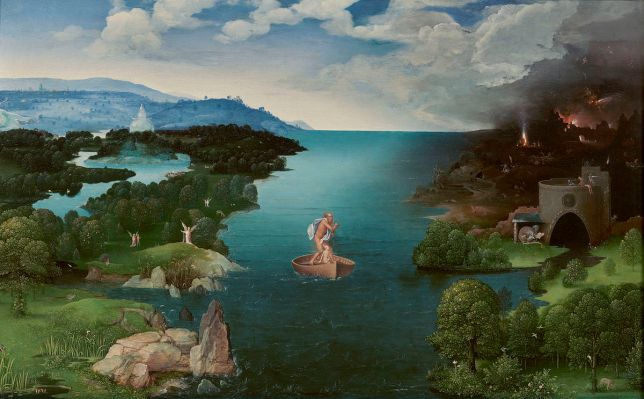
In the West during the Renaissance, art was nevertheless centered effectually sharing stories of specifically biblical, mythological and historical themes. Consequently, few examples celebrating scenery lone in art tin can exist plant of this catamenia. Nevertheless, it is important to annotation that oftentimes these stories were told against a natural scenery background. Furthermore, mathematical advancements in painting technique made during the Renaissance era had a profound effect on landscape painting. It led to a deeper understanding of perspective and proportion, revolutionizing the fashion scenery was depicted.
In fact, landscape painting was only officially considered an independent genre in the 16th century. It joined historical painting, portrait painting, genre painting and even so life. Despite this, information technology was still considered to be of low significance.
For case, although Joachim Patinier'due south Landscape with Charon Crossing the Styx, an appreciation of nature fostered by the artist's travels is displayed. However, the main subject remains the classical mythical tradition of Charon and the Underworld.
The contrasting dimensions of Romantic landscape painting: Pastoral, Picturesque and the Sublime
Mural painting somewhen gained prominence in the tardily 18th century with the rising of Romanticism, and oftentimes connected to acquit a religious significance. Additionally, it became a method of self-expression, with the emotions of the painter and their appreciation of nature demonstrated in the painting. Due to the inherently personal and cocky-reflective nature of Romantic art, it is difficult to distinctly characterize. However, at that place are considered to be iii general categories of Romantic landscape art: the Picturesque, the Pastoral, and the Sublime. All iii landscape painting styles reverberate a response to the rapid urbanization in the Enlightenment era and the Industrial revolution.
The Picturesque
Picturesque paintings showcase the dazzler and wildness of natural scenery, unspoiled by human intervention and urbanisation. This type of landscape painting began when people started to appreciate scenic locations, fearing that in time they would disappear.
The Pastoral

Pastoral paintings principally gloat humanity's taming of nature, that is to say our rule over the natural world. In John Constable's Flatford Mill, this is perfectly exemplified using the river, wooden tools and equus caballus. Furthermore, a contented, peaceful atmosphere is created past the artist'due south soft use of color.
The Sublime

In contrast, the Sublime seeks to brandish the incredible, divine power of nature for a very unlike purpose. Sublime Romantic landscape art focuses primarily on terrifying with the sheer power of the natural world. Information technology heeds warning against those wishing to go against it, such as Industrialists, with the implication that within nature is the wrath of God. An Avalanche in the Alps past Philip James De Loutherbourg perfectly demonstrates this through a contrast between the enormous, jagged cliff confront and the tiny figures cowering from the lethal threat of the avalanche.
Impressionist landscape painting: out in the open
During late 19th century came the nascency of early mod landscape painting, beginning with Impressionism. The invention of transportable oil pigment tubes meant that artists were no longer bars to a studio. As a result scenery painting en plein air became popularized, allowing artists to paint at any moment of inspiration.
Impressionist landscape paintings don't focus on capturing every detail of the landscape. Instead on capturing the energy, portraying cardinal elements such as the low-cal, colors and shadows. The inspiration comes non from the scene itself, but from the initial impression it leaves upon the creative person. For example, ane of the nearly famous Impressionist paintings, and in fact the painting from which the term Impression originates, is Claude Monet's Impression soleil levant. While not explicitly detailed, the painting encapsulates flawlessly the energy of a sunrise, with the employ of color to describe changes in light and mood.
An urban approach to landscape painting: the belatedly 20th century cityscape
The mid-twentieth century modernistic period saw a shift towards towards more concept and abstract fine art. Afterwards, mural art only began to return as a outcome of the figurative art revival of the tardily 20th century. Gone were picturesque country scenes, and stood in their place was the modernistic "cityscape". Cityscapes often depicted urbanisation equally well every bit encapsulating the energy of a urban center.
For example, in Richard Estes' painting Sunday Afternoon in the Park, he depicts and the forefront sunbathers in Central Park in New York, with the city skyline in the groundwork. The landscape painting, created from 17 unlike photographs, aims just to produce a hyper realistic likeness to the scene. Almost indistinguishable from a photo, the painting truly and with pure honesty captures the energy of the urban center.
Today'south interpretations: landscape art in the 21st century
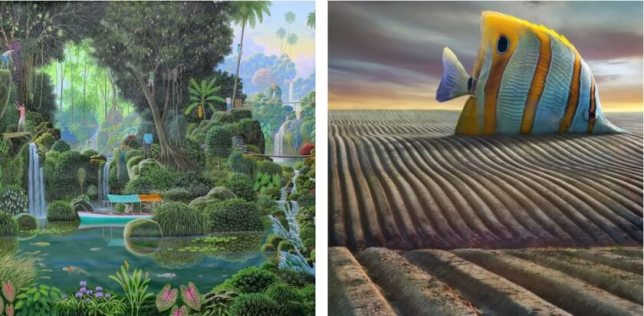
In the contemporary scene, mural art remains highly pop among artists, and has taken on a much more than liberated definition. Artists can frequently be seen to describe inspiration from the various preceding movements. However, they likewise revel in the artistic freedom of originality, both producing incredible results.
For example, in his landscape painting Cueillir des fruits, artist Edivaldo Barbosa celebrates both nature and everyday life in his stunning, colorful work. Furthermore, his rich, bright use of color enhances the exotic abundance and bustling life of the landscape. Every bit, his use of dispersed light through the copse brings a divine quality to the piece.
Meanwhile, photographer Dariusz Klimczak'south Large Fish takes landscape art in an entirely dissimilar direction. He draws inspiration from the Surreal mural art of masters such as Dali and Magritte. Klimczak'south charming creation, based on the concept of a fish out of water, in effect simultaneously surprises, amuses and provokes thought.
Whether it exist in the form of a Chinese shan shui or a modern hyperrealist cityscape, landscape fine art has remained a fascinating and prominent genre of the international world of art. Equally the portrayal of landscapes continues to change, Artsper can't await to see what it becomes in the future!
Source: https://blog.artsper.com/en/a-closer-look/a-brief-history-of-landscape-art-and-painting/
0 Response to "What Is a Picture That Shows a Natural Scene or Countryside Called in Art"
Post a Comment